
Why You Can Read English Perfectly But Can't Speak It (And How to Fix It)
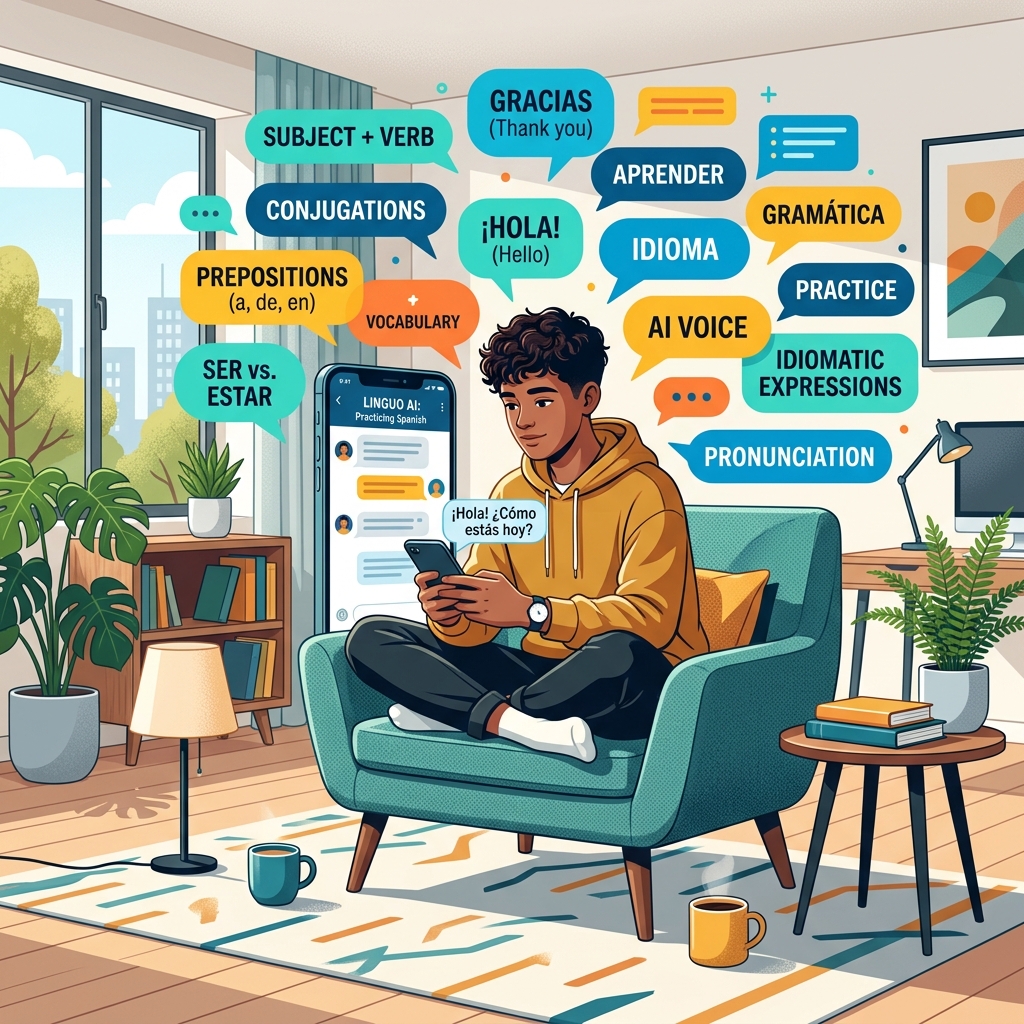
You are reading this sentence right now with zero effort. You watch Netflix without subtitles, you understand complex English podcasts on your morning commute, and you can write flawless emails at work. But the moment you have to actually open your mouth and speak English in a real conversation? Your mind goes completely blank. Your heart races, your palms sweat, and the words you know so well on paper suddenly disappear.
If this sounds painfully familiar, you are not alone. You have fallen into what language experts call the Silent Learner Trap. For years, you’ve been consuming English passively, but you haven’t been producing it actively. The good news? You are actually much closer to fluency than you think. You already have the vocabulary; you just need to build the muscle memory to use it. And contrary to popular belief, you don’t need to pack your bags for London or hire an expensive native-speaking tutor. In this guide, we will explore exactly how to practice speaking English alone, break through the mental block, and finally turn your reading comprehension into spoken confidence.
The Real Reason You Freeze When It’s Time to Talk (Grammar vs. Active Output)
To solve the problem, we first have to understand why it happens. Why does your brain betray you during a simple conversation? It comes down to the difference between passive recognition and active recall.
When you read or listen to English, your brain is engaging in passive recognition. The words are already provided for you; your only job is to decode them. But when you speak, your brain has to do the heavy lifting of active recall. You have to generate the vocabulary, conjugate the verbs, structure the sentence, and physically pronounce the words — all in a fraction of a second.
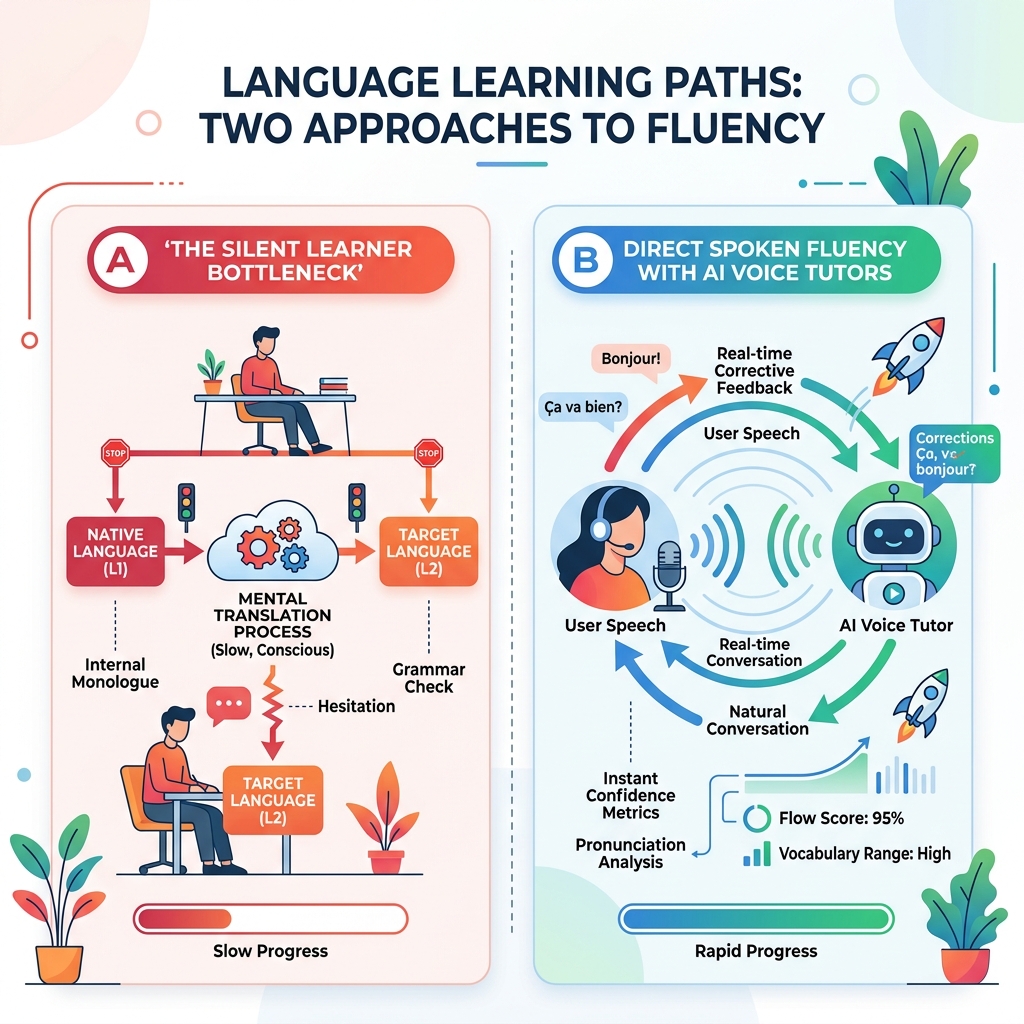
For most silent learners, this process gets hijacked by a psychological roadblock: the translation delay. Here is what is likely happening in your head during a conversation:
- You hear a question in English.
- You translate it into your native language.
- You formulate an answer in your native language.
- You translate that answer back into English.
- You frantically run that English sentence through a mental grammar checklist to make sure it’s perfect.
By the time you open your mouth to speak, the conversation has already moved on.
This hyper-focus on grammar is paralyzing. In a classroom, grammar rules are helpful guardrails. In a live conversation, they act like a speed bump. Native speakers don’t think about the past perfect continuous tense when they are ordering coffee; they rely on instinct and muscle memory. When you freeze, it isn’t because your English is bad — it’s because you are trying to be a human grammar checker instead of an active communicator.
Why Traditional Textbooks and Flashcards Fail for Spoken Fluency
If you’ve been trying to fix your speaking anxiety by burying your nose deeper into textbooks or swiping through thousands of digital flashcards, it is time to stop. These tools are fantastic for beginners trying to build a foundational vocabulary, but they are notoriously terrible for developing spoken fluency.
Here is why: Textbooks are static. Conversations are dynamic.
When you study from a textbook, you are learning how language works in a vacuum. The dialogues are perfectly scripted, grammatically flawless, and entirely predictable. “Hello, John. How are you today?” “I am fine, thank you. And you?”
Real life doesn’t sound like that. Real conversations are messy. People use slang, they mumble, they talk over each other, and they change subjects abruptly. A textbook gives you the map, but it doesn’t teach you how to drive in rush-hour traffic.
Similarly, flashcards train your brain to retrieve words in isolation. You might be able to recall the word “serendipity” when you see a picture of it, but can you weave it naturally into a fast-paced debate about movies? Probably not. True fluency requires context, emotion, and spontaneity. To get there, you have to transition away from memorizing rules and start practicing the physical, messy act of speaking out loud.
How to Practice Speaking English Alone (Step-by-Step Methods)
The biggest myth in language learning is that you need a human conversation partner to become fluent. Finding a reliable partner who is patient, shares your schedule, and provides good feedback is incredibly difficult. Plus, for many learners, practicing with a human triggers the very anxiety they are trying to cure!
You can build incredible speaking fluency completely solo. By forcing your brain to actively output language in a low-stress environment, you bypass the fear of judgment. Here are the two most effective methods to practice speaking English alone.
Method 1: The “Self-Talk” and Shadowing Technique
If you want to speak fluently, you need to get used to the sound of your own voice speaking English.
Self-Talk is exactly what it sounds like: narrating your life out loud. It might feel silly at first, but it is a powerful way to bridge the gap between thinking and speaking.
- Narrate your actions: When you are making breakfast, say out loud: “I’m pouring the coffee now. I think I need to buy more milk later today.”
- Express your opinions: After watching a movie, pretend you are a critic and give a five-minute review out loud in your living room.
- Prepare for future scenarios: Have a job interview coming up? Practice answering common questions to the mirror.
Shadowing is a more structured technique used by professional interpreters to improve pronunciation and rhythm.
- Find a short audio or video clip of a native speaker (a podcast, a YouTube vlog, or a TED Talk).
- Listen to a single sentence, pause the audio, and repeat it out loud, trying to perfectly mimic the speaker’s intonation, stress, and pronunciation.
- Once you are comfortable, try “shadowing” them — speaking at the exact same time as the audio plays, just a fraction of a second behind them.
While self-talk builds your ability to retrieve words spontaneously, shadowing physically trains your jaw and tongue muscles to produce English sounds naturally.
Method 2: AI-Powered Conversational Practice
While self-talk and shadowing are excellent, they lack one crucial element of a real conversation: unpredictability. When you talk to yourself, you always know what you are going to say next. To truly become fluent, you need to practice reacting to someone else.
Enter the era of AI. We are no longer limited to boring, scripted chatbots. Today’s artificial intelligence can simulate real, dynamic, open-ended conversations with stunning realism.

This is where Falable comes in. Falable is designed specifically for learners who understand English but struggle to speak it. By interacting with advanced, empathetic AI conversation partners, you get all the benefits of speaking with a native speaker, with absolutely zero anxiety or fear of judgment.
If you make a mistake, the AI doesn’t laugh or judge you; it simply keeps the conversation flowing while gently offering feedback. You can debate the best sci-fi movies, practice a high-stakes business negotiation, or just chat about your weekend. Because it’s an AI, it’s infinitely patient and available 24/7. You are actively forcing your brain to listen, process, and output English in real-time, bridging that agonizing translation gap once and for all.
What to Look for in an Android Language Speaking App
If you are an Android user ready to take your solo speaking practice to the next level, the Google Play Store is flooded with options. However, not all apps are created equal. When choosing a tool to break the Silent Learner Trap, look for these specific features:
- Flawless Voice Recognition: The app must be able to understand you, even if your accent isn’t perfect yet. If the app constantly misunderstands you, it will only increase your frustration. Look for apps backed by cutting-edge speech-to-text AI.
- Open-Ended Conversations: Avoid apps that just ask you to read a sentence off the screen. You need an app that asks you a question and lets you answer however you want, forcing you to generate language spontaneously.
- Low-Pressure Environment: The interface should feel welcoming and conversational, not like an exam. The goal is to reduce your affective filter — the psychological wall that blocks learning when you are anxious.
- Constructive, Instant Feedback: While you want the conversation to flow, you also need to know where to improve. The best apps will let you finish your thought, and then gently point out a better way to phrase something or correct a persistent grammar mistake.
- Everyday Practical Scenarios: You need practice that mirrors real life — ordering food, asking for directions, negotiating a raise, or making small talk at a party.
Conclusion
Reading perfectly but freezing when you speak is not a sign of failure; it is simply a sign that your brain hasn’t had enough practice in active recall. You don’t need a textbook, you don’t need endless grammar drills, and you certainly don’t need to feel embarrassed. You just need a safe space to practice speaking out loud every single day.
By utilizing self-talk, shadowing, and modern technology, you can build the muscle memory required for true fluency right from your living room. Ready to stop translating in your head and start speaking with confidence? Download Falable on the Google Play Store today and start your first conversation. Your AI partner is waiting to chat!
Practice what you read!
Speak with AI Tutors immediately, get real-time accent reviews, and track vocabulary progress on Android.